Showing posts with label markets. Show all posts

Monday, September 2, 2013

The Floating Market Doesn't Float


My last full day in Myanmar, I was so exhausted from touring every day that I really just wanted to be lazy and stay at the hotel, but the guide had traveled almost two hours to take me out, so I finished breakfast and jumped back into the boat (ok, slowly eased my way).  Our first stop was the floating market. My guide told me, “we are approaching the floating market, but most of it isn’t floating anymore.” The only boat-borne merchants were the tourist souvenir peddlers. All the other market-goers had gone on land.

While visiting the market, we stopped at a large souvenir shop to see the Padaung women that wear brass coils around their necks. “We will see the Padaung ladies here, but they are not from here.” It turns out they are brought in every day to work in the shop and let people take pictures of them. They normally live in the Southern part of Shan State, but tourists require special government permits to travel there, so they come to Inle Lake to earn money posing for photos. The whole visit was beginning to seem a bit comical; the jumping cat monastery where the cats don’t jump, the floating market where the market doesn’t float, and the local ethnic tribe that isn’t local.

We then proceeded to a gold and silversmith shop, where jewelers were toiling away making incredibly intricate gold and silver jewelry and trinkets. One young man was making a series of increasingly large silver rings shaped like fish scales that were eventually pieced together to form a wiggling fish. I was dying to buy some of the things in the shop, but I was down to my last $15 USD for my stay in Myanmar. I knew that I needed to have dinner that night and possibly pay an airport departure tax in Yangon the next day. I think it’s the first time I’ve been in a shop when I literally didn’t have a single dollar to spare.


After the silversmith, we went out to the thousand stupa pagoda. While it’s true that the thousand stupa pagoda doesn’t have a thousand stupas, it’s not quite as funny because there are actually 1054. There
are two paths up to the pagoda, one covered staircase directly to the top of the hill and one that winds it’s way through the village and the forest along the river. We took the latter, and it was a perfect choice. I was paranoid that a snake might crawl out and attack me or fall from a tree at any moment, but we got to see more locals this way instead of just souvenir shops that I could no longer afford. One woman was making fresh rice crackers, and, for the cook inside me, it was very exciting to watch. Here, the rice crackers aren’t fried like usual, rather they are cooked under hot sand over coals. The old woman placed the cracker dough on top of the sand and then scooped the sand over the cracker allowing it to quickly puff and crisp up. After visiting half of the pagoda, the guide suggested that I go around to the other side to see the rest of the stupas. Tired, I told her, “I didn’t count on the first side, so we can just pretend I saw all 1054.”


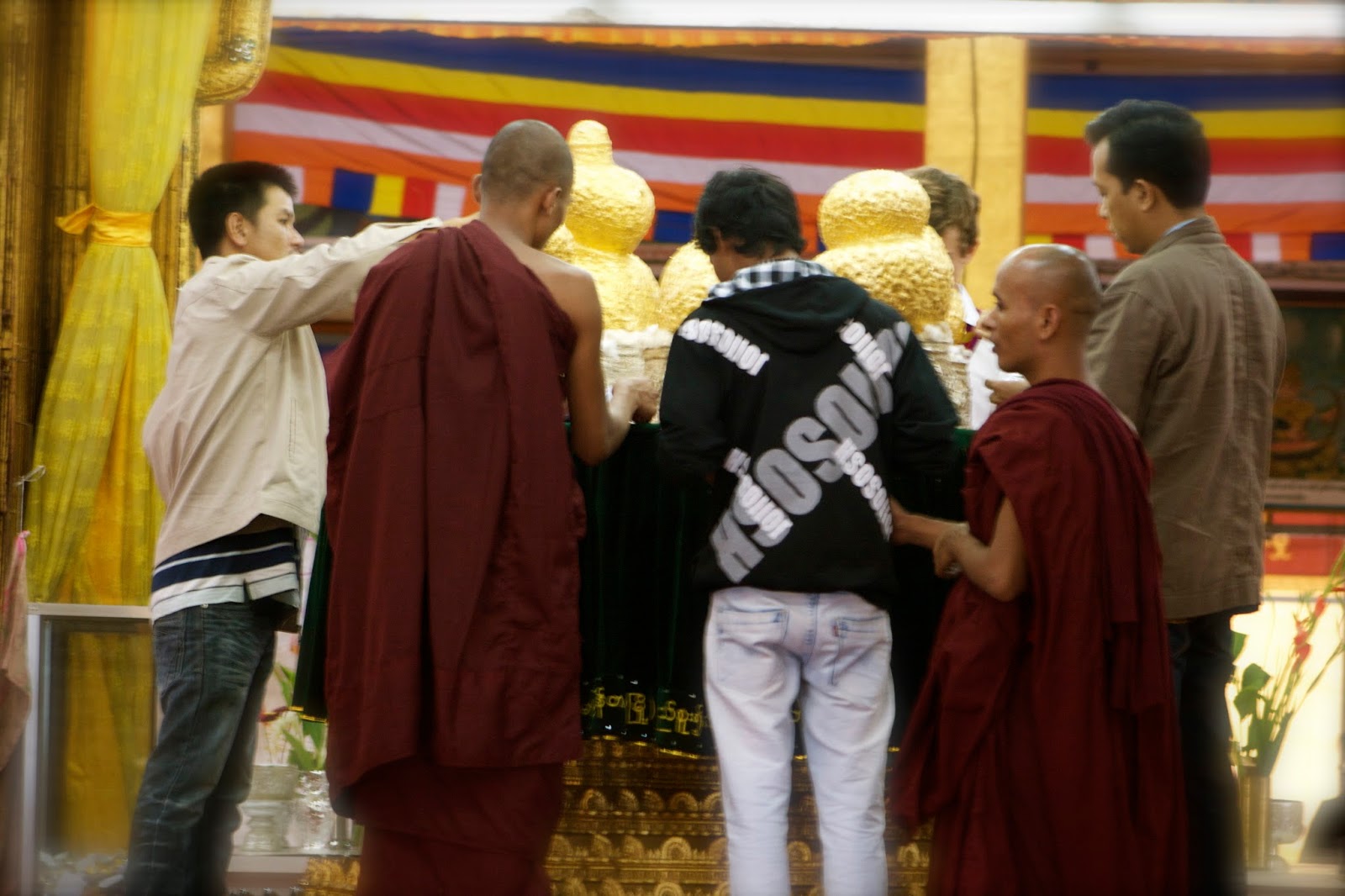
The next stop was another beautiful temple, where there were five famous Buddha statues. “They are known for the five Buddha statues, but you can’t see the Buddha statues anymore.” I was beginning to think this was some giant scam, but it turns out the statues are still there and on display, but worshippers have placed so much gold leaf on them that they have lost their shape and look more like giant balls of gold. The five statues were always considered important, and they are floated around the lake each year on a giant royal barge for 18 days. Once, the barge capsized, and all of the statues fell into the lake.
Four were easily rescued, but the fifth could not be found. Seven days and nine miles later, the fifth statue miraculously floated back home to the temple. Ever since then, people have come in even greater numbers to see the statues and cover them with gold leaf.


After an incredible lunch of local Inle food like a caramel-like chicken with cashews, spicy tomato paste, local lake fish stuffed with onions and tomatoes, fresh green bean salad, and a great pork curry, we headed back to the hotel just in time for a major rain. I sat in my room editing photos and watching the rain beat down on the lotus leaves.


Monday, August 26, 2013

The Middle Way


22.Aug.2013

There once was a King that wished so desperately to follow the ways of the Buddha that he was exceedingly generous. He was willing to give away everything that he had for the happiness of others. If a passing peasant saw his diamond crown and wanted it, the King would freely remove the crown and give it to the peasant as a gift. One day, a demon, wishing to bring bad will to the King, demanded that the King kill his own children. The King thought that to follow the Buddha, he must be willing to give up all his own happiness for others, so he listened to the demon and killed his offspring. This is one of the many stories I’ve heard over the last two days that demonstrate the importance of the Buddhist tenet of finding the middle way. It’s strangely apropos that everything I’ve seen recently has something to do with finding the middle way because an acquaintance on facebook recently posted a status lauding her ability to do nothing because of her generous parents, which sparked a series of both harsh and supportive comments from friends. For me, the combination of this facebook controversy and the series of local legends I’ve heard here in Myanmar pushes me into an evaluative state of introspection. Am I anywhere close to finding the middle way?


Wandering around the Ananda temple in old Bagan, I could here the soothing sound of birds chirping outside while the peaceful yet somehow watchful eyes of the Buddha stared down at me. I’m enjoying life. I take advantage of my many blessings in life to experience new places, new people, and new potential. Travel is my biggest weakness and my greatest strength. I spend more time and money on travel than I probably should, but it has been such a crucial part of my education and who I am that I can’t imagine what my life would be like without it. So far in life, many would say I have not worked much. Firstly, I believe it is far more accurate to say that I have earned very few pay checks in my life because I have worked hard at studying, volunteering, interning, building lasting relationships, and improving myself step by step. Secondly, when I work, I am dedicated to it, and I always strive for excellence and success. I have not, however, accepted the common American viewpoint that the only way to be successful is to work yourself to death. I cannot begin to count the number of teachers over my life that have told me, “quality, not quantity.” This maxim does not apply solely to academics, rather to life in general. Working too much leads to lower overall productivity and reduced work product quality. The same is true for one’s downtime; doing nothing will eventually reduce one’s quality of life in one form or another.

This journey has been a reward to myself for finishing my LL.M. thesis, but in a matter of days, I have managed to learn and experience so much. It is my hope that by putting these moments, these senses, these lessons into words, I might be able to share my experiential wealth with others in some sort of effort to find this elusive middle way.


Yesterday started with a walk through old Yangon. This was the moment that I was first confronted with the decaying tropical grandeur of British Rangoon. I kept waiting to see old English gentlemen turn the corner in linen suits and white caps. We popped in to the old post office to find that time had stood still in this Victorian masterpiece of handwritten bureaucracy. Locals queued up at counter after counter making payments, getting papers stamped, and getting things inspected and weighed before they were finally able to slap a stamp on and drop it in one of the two red boxes at the main entrance for outgoing mail. The old ceiling fans rocked back and forth, ready to tumble from their weary fixtures at any moment. The stamped metal flooring had withstood the test of time, that is, except for the crumbled rusted portions covered with simple sheets of plywood through which I anticipated tumbling to my death, or at least the death of whatever poor local I landed on top of, in the blink of an eye.

From the post office, we continued on to the Strand Hotel, where foreigners have come to waste away their days in Yangon since the 1940s. The bar was a classic wood and marble affair with a beautiful pool table in the corner. We paused for a drink and to soak up the atmosphere. I ordered a $7 USD bottle of San Pellegrino that was large enough to share, and my guide was excited to try both sparkling and Italian water for the first time.

We also walked along the riverfront, and visited a market boat. These large vessels cruise up and down the river picking up people and their goods to sell from township to township. The rusty old boat was packed full of everything from vegetables to t-shirts and families living their lives the only way they know how. A young baby was napping in a makeshift hammock of fishing net hung from the ceiling, kittens roamed about hoping for some food scraps, and women ground their Thanaka to protect their faces from the sun. We visited a local temple before making our way to the National Museum.

Upon arrival at the National Museum, I was warmly welcomed by the new Museum Director. He had been informed about my visit and was eager to hear my feedback. The man knows the Myanmar history better than most, and he has grand ambitions for a museum stuck with the burdens of poor funding and government bureaucracy. He has only been with the Museum for a matter of months, but it was clear he was already doing whatever he could to protect the museum and its treasures from gradual decay and irrelevance. He left me to explore the museum, but the assistant director soon came looking for me to explain some of the exhibits I was looking at. The museum was quite large, and the displays seemed to go on and on forever. One of the most important exhibits is the Lion throne of Mandalay. The throne had been taken to India and later England during the colonial period, something that Myanmar was still clearly bitter about even after the throne was returned. The assistant director explained to me that all of the other thrones were destroyed in fires, so I told him that maybe the greed of the colonial powers had its benefits after all. One hall of the museum shows the geographic origins and traditional clothing of each of Myanmar’s 135 distinct ethnic groups. I was struck by the story of one group’s tribal symbol; it was a bird that can grow very large, and when the female mate dies, the male flies as high into the sky as he can before freefalling to his death. I guess love is a complicated thing even in the animal world.

We rounded out the day with a surprise visit to the local travel agency responsible for my tour and a walk around Chinatown. Since our stop at the travel agency was unannounced, my guide decided to have some fun with the manager and told him I was there to complain about how things had been so far. The manager had fear in his eyes and a knot in his throat when he turned to ask me how things have been since my arrival. There have been few occasions in life where I have seen someone look so relieved as when I told him everything was great. We talked about some of the changes happening in Myanmar, and he expressed his excitement and concern for the rapid growth in tourism. He could not have been happier about the steady increase in foreign visitors, but he also feared what his life would become like as he took on more and more work. As this young man with so much energy, excitement, and pride pushes himself to keep up with the speed of change in this country, will he be able to find the middle way?

Changes are clearly happening sector by sector here because we also visited the antiquated train station. Another grand structure frozen in time, I loved exploring the station and watching the smiling people prepare for their long journeys on rickety trains that had been in use since the 1940s. My guide was also eager to show me “the plastic shop.” It was a warehouse full of everything plastic; I’m pretty sure this is where the spirits of plastic lawn furniture end up after they die. Every hideous color of plastic furniture imaginable towers around you like a forest of Chinese dyes and resin. I felt ashamed for even thinking about the cheap tacky nature of the furniture when my guide proudly said, “we come here for interior decorating; it’s the best most people can afford.”

Before sunrise, we were back on the road to the airport to catch my flight to Nyuang U. We did a quick drive by of “the Lady’s” house, the affectionate term for Aung San Suu Kyi, the mention of whose name could have gotten you arrested a few years ago. At the domestic air terminal, I finally saw the Yangon airport I was expecting. It felt like visits to the Hickory airport during my childhood back in North Carolina. Security was more for show than prevention, at least when it came to foreigners. Passengers lined up with their handwritten tickets to check their luggage and receive their handwritten boarding pass complete with a sticker for the seat number, and a bright yellow airline sticker for the passengers to wear to identify themselves.  The little propeller plane hops from airport to airport in Myanmar like a bus with wings. We swerved from side to side as we powered down the runway, but I made it to Nyuang U, the gateway town to Bagan, in one piece.


Old Bagan is amazing. Temple after temple dot the horizon as far as the eye can see. The problem that I’ve had since I’ve been here is my inability to say no to the people. In my long list of travels, I’ve learned to quite efficiently give people the cold shoulder, but the people here are so nice that I find it difficult to ignore them. One young girl asked me if I’d like to by a small elephant family carved from stone. I smiled and told her, “no, thank you,” but she kept following me. She introduced me to the mother elephant, the father elephant, the brother, sister, and baby elephants. She told me, “it’s ok, think about it, maybe later.” She followed me up the stairs to the terrace, warning me to watch my head the
whole way. After snapping some photos and before heading back down, she asked me again, “you want to buy elephant family?” I asked her how much, to which she replied, “3,000 kyat,” which is roughly $3 USD. Now, I could have said no, or I could have bargained with her to save another dollar, but if my one dollar can help pay for her family’s dinner, how can I in good conscience keep it for myself. I gave her the money, and she ran down the stairs to get me a bag. On the way out of the temple, the mother gave me an almost apologetic thank you that only served to confirm the value of this small purchase to the family. If it had been a larger purchase where I could have potentially saved myself at least $5 USD by negotiating, I would have, but I couldn’t bring myself to quibble over cents that mean so little to me and so much to that young girl. Unfortunately, a dollar here and a dollar there add up eventually, and I might soon run out of room for elephant families in my suitcase.

We ended the day watching the sunset from atop one of the many temples (though one of the few tourists are allowed to climb), and my guide explained to me some of the suffering the local people have gone through over the decades. He was born in old Bagan, but his family was forcefully relocated like many thousands of other families to new Bagan. I could see how he still looked out over the plains of temples with a sense of longing and a connection to his past. Things are relatively good in his life now, but something will always be missing because his heart is at home somewhere that he can no longer be.

I have things very good in life, and I have never had to personally experience the kind of suffering that these people have powered through. My hope is that just by being here, spending my money, hearing their stories, and sharing them with others, I am somehow helping. My path may still be considerably closer to the path of comfort and self-interest, but I try to do my part, and I never take my blessings for granted. I haven’t yet found the middle way, but I am not as far off as some people I know, and Buddha never said that enlightenment came easy.


Tuesday, July 21, 2009

No More Virgins in Chiang Mai


“Passenger Stephen George please come to the service counter.” I thought maybe the announcement had something to do with making sure my luggage was transferred from my Dubai flight to my connecting flight from Bangkok to Chiang Mai, but the news was a little less mundane. The Thai Airways staff had received a message at the gate requesting that they notify me that my flight from Chiang Mai to Luang Prabang in 4 days had been cancelled. I think the gate staffed were pleasantly surprised and somewhat relieved at how well I took the news. I took the phone number for Lao Airlines in Chiang Mai and thanked them for letting me know. Why should I get upset? I’m on vacation.

I made it to Chiang Mai where I was met by a compact, energy-filled, young lady who was to be my tour guide for the next couple days. For those of you that have met my friend Uzma (Hi Uzma!), Gina is the Thai version. Her smile and her bubbly personality were contagious, and I think I spent most of my time with her laughing. Having not slept much since I left Doha, I was a little tired and chose to take a long nap at the hotel when we arrived. Gina returned in the evening to take me to a local khantoke dance performance and dinner.

I had a very large and enjoyable dinner of chicken soup, yellow curry with pork, crispy noodles with tamarind, fried chicken with herbs, fried bananas, chili paste with tomatoes, chili paste with eggplant, sticky rice, steamed rice, fresh cucumbers and long beans, stir-fried mixed vegetables, and fresh fruit with sweet rice cakes for dessert. Gina thought it would be best that I sit on the floor to have a real local experience, and once I saw the “tables”, I completely agreed with her decision. The tables still didn’t have seats, they just brought you and the food a bit higher. By the time the dance performance was starting though, my right leg had gone completely numb. I was trying so hard to follow local etiquette and keep my feet behind me to prevent pointing the soles of my feet at someone (a sign of disrespect in Thailand), but I was beginning to worry that my leg might fall off from lack of circulation. I managed to maneuver into a more comfortable position without offending anyone. On the way back to the hotel, Gina mentioned that she hoped it would not rain in the morning. She explained a local ritual to prevent rain that involves having a virgin place an upside down stalk of lemongrass into the ground. "Problem is, impossible to find virgin now!"

The next day, Gina and I, despite a little rain, went up to Doi Suthep, a local mountain crowned by an important Buddhist temple. The mountain is called Elephant mountain because the legend says that an elephant carried the remains of the King to the top of the mountain and then died itself. “Do you know why the elephant died?” Gina asked. “Try walking up the mountain and you’ll know,” she answered for me.

At the temple, I learned to always walk clockwise around the temples and how to pay respect to Buddha in the Thai style. When visiting the mountain, it is said you are allowed to make one wish, so I followed the tradition and wished away. There is also a very interesting tradition involving asking an elephant figurine any questions you might have. You first ask the elephant your question and then try to lift the figurine with your pinky (for men, ring finger for women). Then, you repeat your question, but ask the figurine to become heavier or lighter if the answer is yes. I tried it, and I liked my answer.

The day continued with visits to a Jade workshop, teak carving factory, silk weaving factory and a few more temples. When the tour ended, Gina asked if I would like to join her for the special Sunday “Walking Street”, a local market where they close down some of the main streets in town to allow vendors to set up their goods for sale. Together, we wandered around town a bit looking at all the cheap goods on offer. We stopped at a street stand to try some of the local noodles, which were fantastic; spicy and sweet, full of flavor, and right up my alley. After our spicy dinner, we grabbed some black jelly, a strange herbal gelatin made from the root of a Chinese herb that supposedly helps lower cholesterol. The jelly is shaved off a giant jiggling mass, placed in a bowl of crushed ice and topped with palm sugar. It was a perfect dessert.

Gina didn’t accompany me on Monday. Instead, I took an all day Thai cooking class. We went to the market in the morning and then prepared six different Thai dishes during the day, eating each one after we were done cooking that particular course. It was a fun class, and Thai food is a lot less complicated than I thought. During my first day in Chiang Mai, I had visited a tailor to have some new suits made for school since many events require formal business attire, so after the cooking class, I stopped by for my final fitting before they pack up the suits and ship them home. You have to love a place where you can get three bespoke suits made in two days and it costs the same as one suit at home. I polished off the day with a walk through the night market where I bought some tasteless t-shirts for gifts.

This morning, I packed up and went with Gina to the airport where we said our goodbyes. Boarding my Lao Airlines flight to Luang Prabang, I wasn’t the only one that found it amusing that we were flying a small Chinese-built propeller plane. Several of the young Western travelers whipped out their cameras and started posing in front of the plane. I had to practically fold myself in half to fit through the door of the plane, and I kept hitting my head on the overhead compartment doors that were a little less than overhead for me. At one point during the flight, people sitting towards the front started turning around with a look that screamed, “What’s that smell?” The smell was our inflight meal being passed out by the stewardess starting from the back. Despite the smell, I chomped right into the pork meatball sandwich. It wasn’t the best meal of my life, but it didn’t kill me.

There’s something delightfully old-fashioned about sleeping in a four-poster bed surrounded by a mosquito net blowing gently under the breeze of a ceiling fan (ok, so I have an AC unit too). I’m laying here getting ready to call it an early night here in Luang Prabang, and I have a very pleasant first impression of this town. The French colonists left their mark on this small town full of colonial era buildings, bakeries and coffee shops, yet the town has a distinctly Lao flair to it. I wandered up and down the main street of town this evening and visited the night market. The people here seem friendly and easy-going, and I think I’m falling in love with the overall atmosphere. It’s hot and sticky outside, but somehow that adds to the experience. I had dinner at a traditional Lao restaurant recommended by my guide here, and I’m not entirely sure what I ate, but I enjoyed it. I started with some fresh spring rolls and then moved on to a Luang Prabang Pork Casserole (really more of a hot pot type dish) with sticky rice. The spring rolls were very familiar, but I’m not sure I want to know which parts of the pig were in my pork casserole. There was a lot of indistinguishable gray and white minced meat, some of which I think were different organs, but even with my highest suspicions, not knowing for sure meant I was able to eat and enjoy. Tomorrow, I have an early start to my Lao adventure, so I’m off to eat my goodnight cream puff (Vive la France!) and drift off to sleep under my mosquito net.

A beautiful day in Chiang Mai

Squat and wish - guess Jessica is good for something!

Gina and I at the Yaang Come Village Hotel

My room at the Hotel Les 3 Nagas in Luang Prabang, Laos